
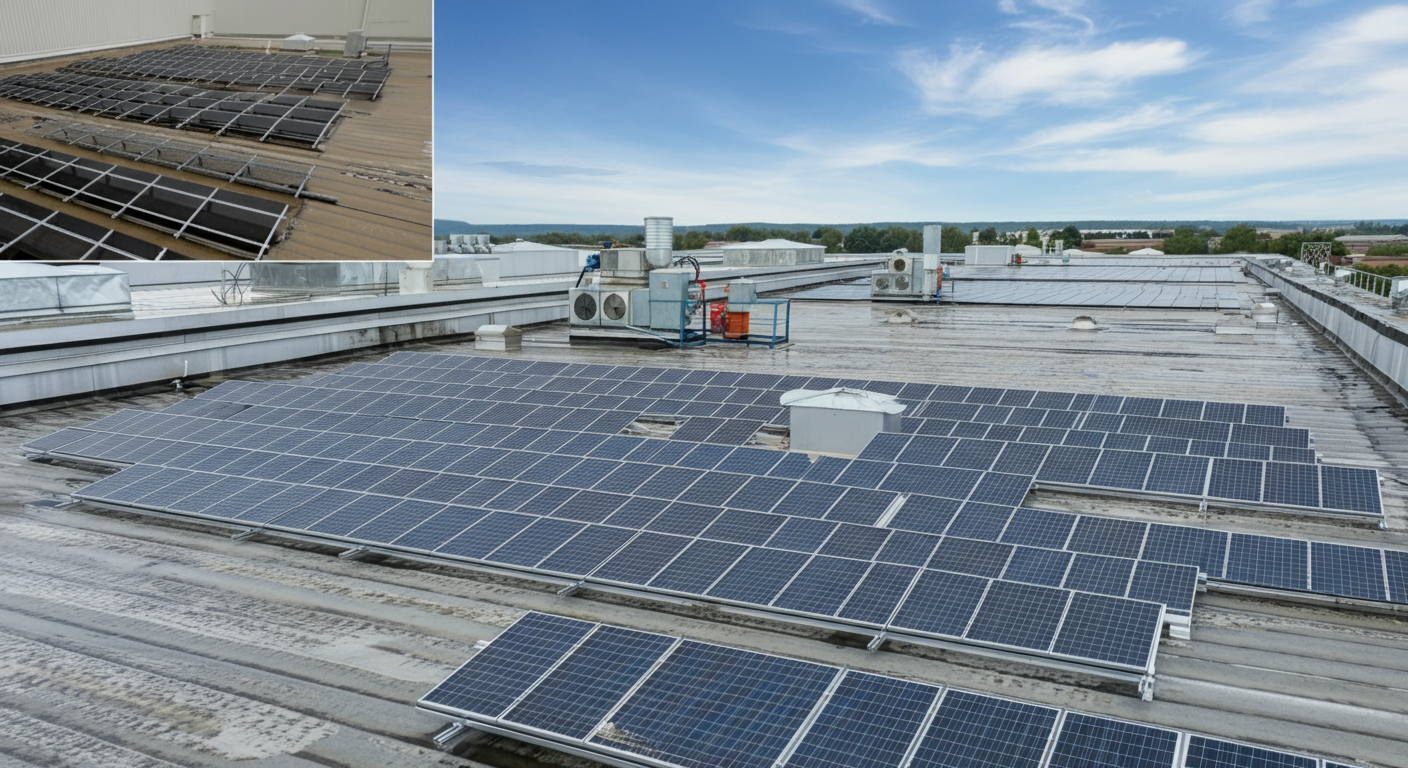
Walk around a commercial property for a moment, and you’ll notice something interesting. Buildings that seem similar from the street rarely offer the same solar potential once you climb up top. Some rooftops spread out like open fields, others break into odd shapes, vents everywhere, uneven slopes, patches of shade where you wouldn’t expect them. Those quirks matter when estimating a commercial solar system size, especially when every square foot influences output.
One question comes up again and again. How much space is required for a commercial solar system?? The answer shifts depending on power goals, panel efficiency, and how the building handles sunlight throughout the day. Not every square foot works equally well, and that nuance catches many businesses off guard.
To understand space needs properly, it helps to break things down into what is measurable and what is not.
The Core Relationship Between Output and Usable Space
There is a general pattern in the industry. A standard commercial solar array producing around 1 megawatt often needs somewhere close to 70,000 to 90,000 square feet when arranged efficiently. Yet this estimate bends quickly depending on roof type and panel density. A commercial solar system size must account for clearances around HVAC units, walkway requirements for safety, and spots where shading pulls down production.
Some flat roofs allow panels to face south at a uniform tilt. Others restrict layout to east-west patterns that use space differently. A high-efficiency panel may squeeze more power from the same footprint, though its cost could shift the payback equation. Every decision influences how many panels actually fit on the property.
How Rooftop Layout Shapes the Commercial Solar System Size
A rooftop often looks large from the parking lot, but shrinks once measured carefully. Odd shapes force gaps. Drainage channels create unavoidable spacing. Even a slight tilt angle, if repeated across hundreds of panels, changes the number that fit.
A few observations tend to hold true:
- Flat roofs usually support more uniform rows than pitched roofs.
- Tilted arrays need spacing between rows so one row does not shade the next.
- Structural limits sometimes reduce the overall coverage even when space appears available.
Because of these factors, businesses often discover their commercial solar system size is determined more by usable square footage than by theoretical potential.
Ground Mounts Offer More Flexibility But Still Have Limits
Some commercial properties shift toward ground-mounted systems. These setups look simpler from the outside, but they carry their own constraints. As you explore different Types Commercial Solar Power solutions, it becomes clear that each system has unique installation factors. Soil density affects trenching. Land slope influences racking. Local rules require setbacks. And if the property operates farm machinery or heavy equipment, the placement must avoid operational paths.
Still, ground arrays open the possibility of stretching the system beyond the building footprint. For companies with room to grow, this flexibility changes the scale of what is possible
Quick Reference Table: Approximate Space Needs for Common System Sizes
The ranges below reflect typical industry layouts and average panel efficiency. They are not absolutes. They simply offer a measurable snapshot.
| Commercial Solar Output | Approx. Panels | Typical Space Needed | Notes |
| 100 kW | 220 to 260 | 7,000 to 12,000 sq ft | Changes with tilt and panel wattage |
| 250 kW | 500 to 650 | 18,000 to 28,000 sq ft | Common for small warehouses |
| 500 kW | 1,100 to 1,300 | 35,000 to 50,000 sq ft | The layout is affected by the roof obstacles |
| 1 MW | 2,200 to 2,600 | 70,000 to 90,000 sq ft | Often requires ground mounting or large flat roofs |
Figures vary by climate, panel efficiency, spacing, and structural engineering findings. They serve mainly as a starting point for early planning.
How Shading Reduces the Practical Size of a System
Shade behaves unpredictably on commercial roofs. A vent pipe may cast only a small shadow, yet the mismatch it creates inside the electrical string can ripple across the array. Taller neighboring buildings can shift shadow lines during different seasons. These patterns can shrink the effective commercial solar system size, even when the surface area appears large enough.
Some projects use microinverters or optimizers to reduce these losses, but they do not eliminate all space penalties. In several layouts, shaded zones must be removed from the design entirely.
Why Energy Goals Matter More Than the Roof Measurements Alone
A facility might use enormous amounts of electricity during peak production hours. Another might spread usage across day and night. Two businesses with identical roofs may need very different commercial solar system sizes because their consumption profiles don’t match.
A building with high daytime loads can use solar output more efficiently than one whose peak usage happens after dark, unless paired with storage. Panel orientation, battery integration, inverter design, and connection type all influence how the array performs within the daily rhythm of the property.
Looking at the Numbers With a Bit of Caution
It is tempting to calculate space strictly by wattage per square foot, but real sites rarely behave that cleanly. A slight change in tilt angle might reduce the number of rows. A new HVAC unit installed later can take up space previously assumed to be available. Even local permitting rules may require additional walkways or structural upgrades that cut into the usable footprint.
Because of these variables, the commercial solar system size becomes a product of engineering judgment as much as raw space. There is no single formula that works universally.
From Concept to Reality: Get Your Commercial Solar System Right the First Time
Once you understand the rough space needs, the next step usually involves a more technical survey. If you are thinking about Commercial Solar Installation or considering Solar Installation, this is where an on-site evaluation becomes essential. A team checks shading patterns, roof strength, obstructions, and electrical tie-in points to determine how much of the property can actually support an efficient build.
If you prefer a company that manages structural review, layout optimization, and long-term reliability, TX Solar Batteries comes up as an option. They work with commercial solar panels, full commercial solar systems, and large battery integration. The benefit is simple. Instead of guessing your commercial solar system size, you get a design based on measurements and equipment aligned with real-world performance.
Schedule Your On-Site Evaluation Today and Unlock a Custom Solar Solution That Works for Your Business!
Conclusion:
Space requirements depend on more than roof area. Orientation, shading, panel density, safety pathways, electrical layout, structural limits, and long-term expansion all influence the right commercial solar system size for a property. You can estimate, but the precise figure appears only after an engineer studies how sunlight actually behaves on that specific building.
Solar sizing is less about perfect formulas and more about understanding how a property works under real conditions, and that is where the most accurate planning begins.
FAQs
Does panel efficiency change the required space for a commercial system?
Yes. Higher efficiency panels can reduce the total square footage needed, though cost and availability influence the choice.
How much space does shading typically remove from a layout?
On many properties, five to twenty percent of the roof becomes unusable due to shading or obstructions.
Can a building support a system larger than its roof area?
Yes. Many businesses use ground mounts or carport structures to expand their commercial solar system size.
Do commercial solar installations always require structural upgrades?
Not always. It depends on roof age, load capacity, and the local code requirements found during inspection.
Is battery storage necessary for commercial systems?
Not required, but it can help if peak usage falls outside sunlight hours or if the facility wants resilience during outages.